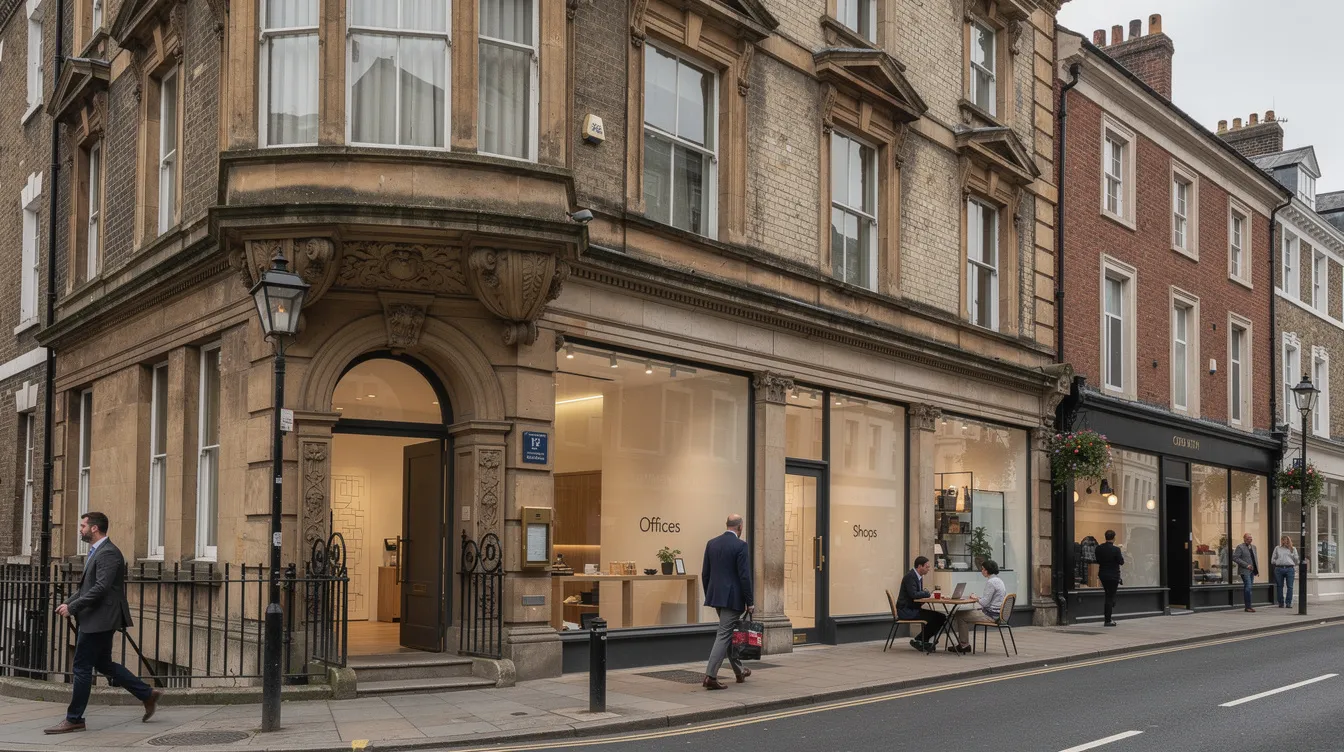

Reusing and adapting historic buildings is the most powerful form of climate action available to the construction industry right now. This isn’t a matter of people just liking old buildings – although let’s be honest, who doesn’t? – but a seriously grounded response to the climate crisis that recognises the massive carbon value already locked up in our existing building stock.
When you add up all the carbon emissions generated by a building over its entire lifespan – not just the bit that happens while people are living or working in it, but from the production of the bricks to the day the place comes crashing down – then almost all the time, retaining the old building comes out on top. Especially in places like the UK where so many of our buildings are old, and where knocking them down would mean releasing all the carbon we’ve already invested in them – a sunk cost that can never be recovered.
Heritage architects are specialists in saving buildings with cultural or historical value, making sure they stay true to themselves while still meeting modern needs and regulations. Their work overlaps with that of conservation architects, who try to do as little as possible to a building so that future generations can enjoy it just as we do today. They also work with listed building architects, who look after Grade I, II*, and II listed buildings as designated by English Heritage. Meanwhile, sustainability architects are all about finding ways to reduce the carbon footprint of buildings – and increasingly, all these roles are coming together to make the case for reusing old buildings rather than tearing them down.
This article is going to cover a lot of ground:
- The difference between the carbon emissions that go into building a place, and the carbon emissions that go into keeping it running (and the carbon emissions that add up over the whole of a building’s lifetime)
- All the research that shows reusing old buildings is a better way to tackle the climate crisis
- How old buildings can be used as a kind of ‘carbon asset’
- The tension between the carbon that goes into building something in the first place, and the carbon that gets used up keeping it going
- Why understanding how to factor carbon into your building plans is a vital skill for anyone working with old buildings
- How policy, economics, and planning can all be used to persuade people to keep old buildings rather than knocking them down
- Collaboration between heritage and sustainability experts
- The best ways to bring old listed buildings up to modern standards without losing their character
- Communicating the importance of heritage and climate change to communities
- Where we’re headed in terms of making a built environment that really does work for the planet
As architectural practices become more and more focused on reducing waste and promoting biodiversity, sustainability needs to be a core part of the design process from day one.
Making Sense of Embodied, Operational, and Whole-Life Carbon
Embodied carbon is the carbon that gets emitted during the whole process of making a building – from digging up raw materials to putting the final finishing touches on it. In other words, it’s all the carbon that goes into the bricks and mortar themselves. Operational carbon, on the other hand, is the carbon that gets used up keeping a building running – heating it, lighting it, powering all the equipment and so on.
Whole-life carbon is just a fancy way of saying the sum of all the operational and embodied carbon emissions that end up going into a building over its entire lifespan – which is usually 60 years, according to the UK Green Building Council. This way of thinking about carbon captures the whole impact of a building from start to finish – and increasingly, it’s about finding ways to get the most out of the carbon we’ve already invested in our buildings.
The RICS Whole Life Carbon Assessment breaks all this down into five different stages:
- Product stage: that’s raw materials, transportation and actual building of the thing
- Construction stage: transport to site and getting the place built
- Use stage: maintenance, repairs, replacing bits and keeping the lights on
- End-of-life stage: demolition, all the hassle of getting rid of the old building and dealing with the waste
- Benefits beyond the system boundary: what happens to materials and buildings beyond the point where they’re no longer ‘in use’. Part of this is about reuse and recovery, and reducing waste while still preserving all the heritage value of the old building.
The thing is, for lots of old UK buildings, the upfront embodied carbon has already been spent. It’s a sunk cost – the carbon that’s been released decades or even centuries ago that demolition can’t recover. When we knock down a Georgian townhouse or a Victorian mill, we’re basically just throwing that carbon investment away and having to spend it all over again.
The RIBA Sustainable Outcomes Guide has marked a big shift in how architects think about sustainability: from mainly focusing on reducing operational energy to balancing both that with the embodied carbon that went into making the place in the first place. This makes sense when you think about how much the grid is changing – if you’re using less and less energy from fossil fuels and more and more from wind or solar, for example, then the embodied carbon becomes a bigger part of the overall carbon picture.
For heritage professionals, this all means becoming experts in incorporating sustainability from the very start of the design process – making sure that any new work on an old building is going to make it more environmentally friendly, not less. And that means thinking about biodiversity too – promoting and improving it, as well as cutting carbon and waste.
Why Keeping Old Buildings is Often a Lower-Carbon Choice
In most cases, it makes a lot more sense to keep and upgrade an old building rather than knocking it down and building something new. And one of the main reasons for this is that all the carbon that’s already been invested in that old building is just sitting there, waiting to be used rather than released again. This is a key argument for heritage architects to make – that of course keeping old buildings is often the lower-carbon choice. And when you think about it, old buildings also often have features that can actually help cut carbon emissions in the first place – like using natural light and ventilation, which we’re going to come back to in a bit.
Research by Freya Wise and her team at the Open University have put some hard numbers to this for mid-20th century buildings in the UK – and its good news for anyone who likes the idea of breathing new life into old buildings. It turns out that keeping an old building and giving it a new lease on life cuts whole life emissions by 40-60% compared to knocking it down and starting from scratch.
When you’ve got a mid-century concrete frame that’s been fixed up, it turns out you’ve actually ended up with a structure that emitted less carbon than if you’d built a brand new one out of steel or concrete. And carbon payback periods for new builds – basically the time it takes for a new building to ‘pay off’ the carbon debt of building it in the first place – can be 30-50 years or more, which is a long time given that the electricity grid is getting cleaner all the time.
The UKGBC (‘Net Zero Carbon Buildings: A Framework Definition’ – 2019) reckons that avoiding the carbon costs of building something new from scratch in the 2020-2040 period is a top priority. This is the period when every tonne of CO2 counts – before 2050, we’ve got to get to net zero. And then there’s another report (RIBA & Architects Declare ‘Built for the Environment’ – 2021) that says 40% of global CO2 emissions come from buildings – with half of that coming from the materials used in the first place.
Now let’s look at some concrete examples. Just to give you an idea of what we’re talking about, here are the carbon costs of three different approaches:
- Demolition and new build for a mid-sized office: typically 800-1,000 kg CO2e per sq m\
- Deep retrofit of the same building: typically 250-450 kg CO2e per sq m\
- Whole life savings: 350-750 kg CO2e per sq m – just from keeping an old building and not knocking it down.
Now, the concept of ‘carbon payback’ is pretty critical here. How long would it take a brand new building to pay off the carbon costs of building it in the first place, by being more efficient and using less energy? In a lot of cases the answer is 30-50 years or more, which is a very long time – and by the time you get to that point, the electricity grid is probably getting a lot cleaner, which makes the efficiency gains of the new building a lot less relevant. Another thing to keep in mind is that using natural materials is a good way to go, because they need less processing, and they can even help to lock in carbon, which further reduces the carbon costs of the materials.
Some other interesting findings from current research are:
- Wise’s research shows that reusing a building is a lot better for the planet than rebuilding one – 300-500 kg CO2e per sq m versus 900+ for rebuild\
- The EnerPHit retrofit standards (15 kWh/m²/year) are achievable in 50-70% of heritage cases without fully replacing the building\
- Repairing a building – like, for example, repointing the lime mortar (50 kg CO2e per m3 vs 400 for cement) can cut the carbon costs of the materials by 70-90%\
- The UKGBC says that keeping the building is the default starting point for any project
Finally, heritage architects have got to navigate all the complex rules around listed building consent – which remains one of the biggest hurdles to delivering sustainable outcomes for old buildings.
Historic Fabric as a Climate Asset
A lot of old buildings in the UK use materials that are inherently low-carbon – and they already embody less carbon than a lot of modern systems. Solid brick, timber frames, air-lime mortars and natural slate were all used in ways that sequestered CO2 over time – via a process called carbonation. And all this carbon is sunk – we’d be daft to chuck it out.
Heritage projects require a willingness to dig deep into the history and original construction of the building – and heritage architects conduct meticulous surveys and historical research to get a proper understanding of a building’s significance before they even think about making any changes.
All sorts of old buildings have got features that are actually pretty smart – think about the thick walls that provide thermal mass, the high ceilings that let hot air stratify, or the sash windows with shutters that cut heat loss by 20-30%. These aren’t primitive features to be overcome – they’re sophisticated design responses to the climate that are still totally relevant today.
Here are some real examples of buildings that have been saved from the scrapheap:
- Warehouse to office conversions in Manchester that retain the brick vaults and iron columns, saving 60% of the embodied carbon compared to a new build – according to LETI data\
- Victorian terrace retrofits in London that use internal limecrete insulation (just 200 kg CO2e per sq m) to get to Passivhaus, and reduce operational energy by 80% – thanks to the clever work of Purcell Architects\
- Georgian townhouses in Bath that use secondary glazing to reduce u-values from 5 to 1.8 W/m²K, and breathable woodfibre boards to preserve the moisture-regulating hygric capacity of the old building\
- 1930s schools that got a makeover with roof insulation and heat pumps, and now operate at 50 kWh/m²/year\
- Post-war mills in Yorkshire that have been repurposed as low-carbon offices, with payback times of 30-50 years or more.
Integrating green spaces and gardens into adaptive reuse projects is a great way to enhance user wellbeing – and boost biodiversity in the city. And by drawing nature in to built environments, we can create healthier, more resilient architecture.Careful repair of existing timber, masonry & metal-work usually produces a lot fewer emissions than replacing the whole thing – even when the replacement materials claim to be super energy efficient. People in the conservation game, like conservation architects and listed building architects, have a vital role in finding a balance between making old buildings more breathable, stopping moisture getting in and making them more energy efficient – all without messing up the historic fabric.
Building types that lend themselves really well to being reused include:
- Victorian terraces: solid brick walls that store heat well, flexible room layouts and often just need some internal insulation and draught-proofing to be good as new.
- Georgian townhouses: top-notch materials, loads of space and a layout that works well with secondary glazing and gentle heating upgrades.
- 1930s schools: robust construction, big windows that let in loads of natural light and can be managed to reduce overheating, and roof spaces that are perfect for insulating.
- Post-war civic buildings: easy to redo the interior to get a new use out of them, with lots of potential for carbon savings
- Industrial mills: cast iron and masonry construction, big open floor spaces, loads of character… and loads of value if you convert them
The Tension Between Carbon in the Building and How it Performs
There’s a common argument that says you can justify knocking down a building because a new one would be so energy efficient it would make up for the carbon cost of building it in the first place. But lots of experts are starting to disagree with that.
The RIBA Sustainable Outcomes Guide has targets for how energy efficient a building needs to be – but it also says you have to think about the carbon cost of the building itself when making decisions. For heritage architects, that means coming up with strategies that cover both how a building is used and the energy it uses, including making sure the business side of things (like travel, energy use and so on) is also as low carbon as possible.
If you build a new building that only uses 30kWh/m²/year of energy but the carbon cost of building it was 1,000kgCO2e/m², it doesn’t look so good next to an old building that has been done up to use 50kWh/m²/year of energy but only used 350kgCO2e/m² to do the work. Freya Wise’s work has shown that in some cases knocking down a building might actually make it a bit more energy efficient, but at a huge upfront carbon cost that would take decades to pay back.
As the grid gets cleaner – and it will – that situation gets even worse for new-build.
UK grid decarbonisation is making the case for reusing old buildings stronger every day. Electricity emissions have gone from around 500gCO2/kWh in 2010 to under 200gCO2/kWh recently, and projections suggest it will get to 50gCO2/kWh by 2035. As the operational emissions of buildings get smaller, the carbon cost of building the thing in the first place becomes the dominant factor.
Let’s look at some typical scenarios and their whole-life carbon trajectories:
- Lightly upgraded existing building: 500kgCO2e total carbon, 80kWh/m²/year – not too bad, but pretty low-intervention.
- Deep retrofit to EnerPHit standard: 450kgCO2e total carbon, 15kWh/m²/year – excellent performance, minimal upfront penalty.
- Partial demolition & extension: 700kgCO2e total carbon, 40kWh/m²/year – mixed results, depends on the context.
- Full demolition & new build: 1,100kgCO2e over 60 years, 30kWh/m²/year – lots of carbon for something that’s brand new.
“Fabric First” approaches – like getting the insulation right (U=0.15W/m²K) and draught-proofing – can really reduce operational energy without needing to replace the whole building. You can even keep the historic fabric intact while making the place more energy efficient.
When you’re upgrading heritage buildings to make them more accessible and safe, it’s essential to keep the disruption to a minimum and avoid messing with the original layout too much.
Whole-Life Carbon Accounting – a Core Skill for Heritage Pros
Heritage architects, conservation architects and listed building architects all need to get a handle on carbon accounting to make a case for retaining buildings in planning and client discussions. Carbon accounting and heritage projects are often complex, so it makes sense to have a multidisciplinary team on board.
It’s no longer a nice-to-have, it’s something you need to do to make a strong case against demolition.
We’re using advanced tech like 3D laser scanning and BIM to document heritage projects accurately. Condition surveys using 3D scanning or thermal imaging can even help diagnose structural issues.
Key UK tools & standards that heritage pros should master include:
- RICS Whole Life Carbon Assessment: the standard way to work out emissions across all stages of a building’s lifecycle
- LETI embodied carbon benchmarks: targets and guidance for reducing upfront emissions, and flagging high-carbon materials like cement (900kgCO2e/t)
- UKGBC guidance on life-cycle analysis: frameworks for comparing options and choosing the best one* Environmental Product Declarations (EPDs): getting a real grip on the materials we use – the facts and figures to base our decisions on
Being able to say “Option A (demolition) = 45,000 tonnes CO2 equivalent, Option B (retrofit) = 20,000 tonnes CO2 equivalent over 60 years” is essential – it’s a language that everyone in the planning process understands and respects.
The “Built for the Environment” report is calling for a major shift in how we approach sustainability in the building trade. Every single project needs to consider the long-term carbon impact, and that means we need to make sure the skills are there to make that happen – in the classrooms, on the training courses, and in the CPDs.
Heritage architects need to have a good grasp of the basics – a minimum level of carbon literacy that includes:
- Understanding where emissions come from: what are Scopes 1–3 emissions, and how do they add up – direct, indirect, and supply chain effects (and that’s the bit that makes up about 80% of the embodied carbon)
- Reading and making sense of energy models: using tools like IESVE for heritage envelopes, and getting to grips with the data
- Making sense of Environmental Product Declarations: getting to know what those numbers mean – like brick at 0.2-0.4 kgCO2e/kg
- Picking up on carbon hotspots: demolitions are a big one, at 150 kgCO2e/m³ waste, and then there’s the cement in repairs, and all those new structural elements
- Modeling whole-life scenarios: comparing retention, retrofit, and replacement options in cold hard numbers
Making the Case for Retention: Policy, Economics and Planning
Planning policy is getting serious about climate change, circular economy and resource efficiency – and so is the National Planning Policy Framework. It’s now expected to quantify carbon savings when doing a Heritage Impact Assessment – that’s the balance between significance and development needs in the same report.
Heritage architects can make a strong case for retention, showcasing how it fits the plan. Conservation of significance and carbon savings work together, not against each other – they’re both good for proposals in planning terms. Retaining and adapting historic buildings can even improve wellbeing for occupants and the wider community by integrating features like natural ventilation, daylight, and green spaces that are good for health, comfort and our connection to nature.
Building a solid case for retention will involve:
- Whole-life carbon calculations that compare demolition and retention in clear, easy-to-read figures
- Cost comparisons over the building life cycle, and that often means retrofit is 20-30% cheaper in the long run
- Evidence of adaptability and future-proofing showing how the original building can serve new purposes
- Getting on board with local climate emergency declarations, which now 80% of UK councils have signed up to
- Some good precedents and case studies – like Bristol’s listed town hall retrofit, which managed to get from an EPC C to an A and knocked 65% off energy usage
Heritage architects do feasibility studies to help clients see what’s feasible, and then they guide them through the complexities of listed building consents and local authority negotiation, making the planning process a lot smoother. They also prepare heritage statements and significance appraisals to support planning submissions and show what a valuable asset retention is.
There are a few common worries that clients have – about higher maintenance costs, regulatory complexities, uncertainty about performance. But those can be addressed with some solid data and reference to successful projects that show it can be done. And then there’s some money available – Heritage Fund support can get you up to £5m for retrofits, and there’s tax incentives too.
Section 106 obligations are increasingly getting green mandates that retention projects can actually meet. So, if reuse can tick that box, that changes the conversation entirely.
Collaboration Between Heritage and Sustainability Architects
So, heritage architects and sustainability architects can team up from RIBA Stage 0-1 and get low-carbon, retention-first strategies locked in before demolition is ever assumed. Early collaboration stops us assuming a new build is the only way forward, and explores reuse options before they’re ruled out.
Joint workshops with conservation architects, structural engineers, services engineers, and cost consultants let the design team test reuse options against performance targets. It’s a chance to explore new ideas and approaches, which means we’re more likely to get innovative, sustainable heritage interventions. This collaborative approach means that heritage significance, carbon performance and commercial viability are all considered at the same time, not one after the other.
Good practice on a typical project would be:
- Early fabric surveys using thermal imaging to see where heat is leaking out (and that often reveals 30% of losses through specific elements)
- Hygrothermal modeling using tools like Wufi to understand how moisture and heat move in traditional construction
- Assessing spatial adaptability to figure out how the existing building can be adapted for new uses
- Iterative carbon modeling doing different intervention levels and comparing retrofit at 40% baseline versus new at 100%
- Material passports documenting what’s there for potential future reuseCircular economy principles – designing for the dis- assembly, salvage and reuse of historic components like slate (which is 100% carbon-neutral when reused) – should get factored in even when some demolition is unavoidable . Heritage architects make this approach happen, tying together environmental, cultural and economic outcomes for the clients.
This collaboration isn’t about heritage professionals acting as “roadblocks” to development. It’s about bringing their expertise to help achieve better results across multiple value dimensions.
The Role of Listed Building Architects in Deep Retrofit
Listed buildings – the Grade I, II* and II buildings in England and Wales, or Categories A, B, and C in Scotland – are often thought to be impossible to upgrade for energy performance. But that’s just not true. And listed building architects are now showing us what’s possible with careful interventions that respect the building’s physics.
There’s a whole range of retrofit strategies available for heritage architects to get to work with – from passive design solutions to advanced tech integrations – and that allows for a whole spectrum of sustainable and energy-efficient outcomes. Restoring and reconstructing heritage buildings requires really thorough research to get the original appearance back right, so you end up with a historically accurate result. The “less is more” approach is often the way to go, to only do the repairs that need doing and try to keep as much of the original fabric as possible.
Sustainable integration of heritage buildings is all about upgrading them with modern amenities while still keeping their historical character.
Listed building architects sit down with conservation officers to work out sensitive measures that respect both the building’s significance and the science behind its construction. And they’ve come up with some really effective strategies, including:
- Secondary glazing: reducing a building’s U-value from 5 to 1.8 W/m²K without having to replace the original windows – that’s a 40% heat gain reduction, and you can actually reverse it if you need to
- Lime-hemp insulation: getting a U-value of 0.18 W/m²K while sequestering 100 kgCO₂e/m³ – and it’s compatible with vapour-open traditional construction
- Underfloor air circulation improvements: reducing thermal bridges without having to make any visible changes
- Air-source heat pumps: getting a COP of 3.5 in masonry buildings when you get the spec right, often with a discreet external unit placement
Understanding the building’s physics in traditional construction is key. Assemblies that let moisture migrate safely are vapour-open – but impermeable foams cause rot by trapping the moisture and doubling the risk of interstitial condensation. So careful detailing around thermal bridges is crucial to stop the cold spots that can cause damage.
The Grade I Elizabeth Tower in Westminster is a great example of what’s possible: draught-proofing interventions delivered a 25% energy saving without compromising the building’s extraordinary significance. Such successful retrofits become case studies that help shift policy and public expectations about what’s possible.
The longevity of listed buildings – many of which have stood for centuries – gives us reassurance that investing in sensitive retrofit will pay off for future generations, not just the folks who are with us now.
Implementing a Circular Economy in Building Retention
Implementing a circular economy in building retention is becoming a cornerstone of sustainable practice within the construction industry, especially when working with historic buildings and existing buildings. A circular economy approach aims to minimize environmental impact by designing out waste, keeping materials in use for as long as possible, and regenerating natural systems. For heritage architecture, that means rethinking the lifecycle of building fabric – not as a linear process of extraction, use and disposal, but as a continuous loop of conservation, adaptation and renewal.
Conservation architects and the wider design team have a big role to play in this transition. By prioritizing the reuse and recycling of materials, they help reduce the emissions and resource consumption that typically come with new construction. Salvaging original materials – like bricks, timber and stone – not only preserves the integrity and character of the original building but also cuts down on waste and the carbon footprint of a project. When new materials are needed, picking low-carbon options like reclaimed wood or innovative composites further supports the circular economy and boosts the building’s environmental credentials.
A circular economy mindset also encourages the integration of green technologies and energy-efficient systems into heritage retrofits. Upgrading existing buildings with modern services like heat pumps, LED lighting and smart controls can dramatically reduce energy use and operational emissions, making historic spaces more efficient and accessible for contemporary needs. These interventions, when designed right, respect the complexity and significance of heritage assets while delivering tangible improvements in wellbeing for occupants and the wider community.
The benefits of this approach stretch way beyond environmental impact. By turning existing buildings into lively community-focused spaces, architects and designers can foster a sense of identity and continuity, linking the past with the future. Circular economy principles support the creation of adaptable, resilient environments that can evolve with changing needs, ensuring that heritage buildings remain relevant and valued for generations to come.
Ultimately, the successful implementation of a circular economy in building retention needs a deep commitment to collaboration, innovation and respect for both tradition and progress. It calls on the expertise of conservation architects, the vision of the design team and the engagement of clients and communities. By embracing this approach, the built environment can move towards a more sustainable, efficient and regenerative future – one where the responsibility to mitigate environmental impact is matched by a dedication to preserving the integrity and value of our shared heritage.
Communicating Heritage and Climate Narratives to Communities
Communicating circular economy principles in building retention to communities is a bit of a challenge. You need to convey the benefits of this approach in a way that resonates with people’s everyday experiences. Heritage is more than just a collection of old buildings – it’s a way to understand where we came from and what we value. Climate narratives are all about the future we want to create – one that’s more sustainable, more resilient and more equitable.
When we communicate heritage narratives effectively, we can unlock the potential for building retention as a force for social change. By showing how existing buildings can be adapted and renewed, we can inspire people to care about the places that have shaped their lives. And by highlighting the role that heritage buildings can play in mitigating climate change, we can galvanize support for sustainable retrofitting and retrofitting projects.Heritage architects can approach public consultations and community engagement as a chance to frame projects not just as cultural stewardship but as a climate responsibility too. With their expertise in getting the community on board, heritage architects can really make people understand the importance of historic places & what role they’ll play in the decades to come. Heritage architecture is all about getting to the heart of a place & its story – its significance to the people who use it, the role it needs to play, and how it can meet modern needs while still being a part of history that we can learn from.
The narrative of saving resources for the future by caring for buildings from the past is one that has a lot of strength behind it. The carbon story of a building – how much carbon went into its original construction, how much that gets saved when it gets reused, & how upgrades can extend its life right into the 21 century isn’t something to be underestimated. Putting a face to abstract carbon accounting gives people a much clearer view of what’s going on.
When it comes to making the climate case clear & compelling, some good tools to use are:
- Simple infographics: “this 1850 building’s sunk carbon is the equivalent of 100 new homes’ emissions—by reusing it, we save 10,000 tCO₂e”
- Tours of reused buildings: show how a space has been transformed without losing its character or embodied carbon
- Interpretive panels: explaining how sustainable conservation work is part of what makes a building’s heritage so special
- Collaboration with local history groups: localising climate narratives by drawing on stories about tradition & continuity
- Before-and-after presentations: showing how a building’s got improved wellbeing & performance alongside its retained identity
When residents start to see their familiar buildings as carbon assets rather than liabilities, you start to get a different conversation going. Heritage becomes not just about the past but about making a commitment to the future.
Future Directions: A Retention-First, Low-Carbon Built Environment in a Climate Emergency
Demolition-led development is getting harder & harder to justify when you put whole-life carbon at the centre of the argument. The evidence is pretty clear: retention almost always outperforms replacement, & that gap is only getting bigger as the grid decarbonises & embodied carbon becomes the thing that matters most in building-related emissions.
Heritage and sustainability architects are really in a great place to lead the built environment towards genuinely sustainable outcomes – not as a defensive posture but as an opportunity. If they can get involved earlier in the decision-making process, they can drive discussions about what gets built and how, & make sure that sustainable principles are in place from day one.
Key actions for the profession now are:
- Getting whole-life carbon assessments into every heritage project as a matter of course, alongside the measured surveys
- Strengthening cross-disciplinary training, so that heritage pros can talk carbon as easily as they can discuss significance
- Working with policymakers to change the rules to prioritise reuse – eg by having carbon weights in listing decisions & planning assessments
- Building the case with published studies, so that others can see how to follow in the footsteps of successful precedents
- Innovating in low-impact retrofit tech that respects traditional construction while hitting ambitious performance targets
Making sure heritage buildings stay resilient & sustainable means long term maintenance plans & regular inspections to prevent structural failures – it’s what case studies like the redevelopment of the former Bötzow Brewery in Berlin show. It’s also what Walters & Cohen showed with their work at the Portsmouth Historic Dockyard, & what’s happened with the new building at Regent High School.
The UK Green Building Council, RIBA (including the Sustainable Outcomes Guide), & the “Built for the Environment” report all give a steer on how to get heritage practice lined up with the climate targets for 2030 & 2050. These are not competing agendas but complementary paths to a more resilient low-carbon future for UK cities, towns & landscapes.
Getting to the point where historic buildings are seen as climate assets rather than liabilities will shape the future for UK cities, towns & landscapes. The waste of demolition – both cultural & environmental – is getting harder to justify with every passing year. Heritage architects have the skills & knowledge to make that understanding mainstream, & mitigate climate impact while preserving the identity & value of our building stock.
The greenest building is truly the one that already exists, & heritage architects hold the keys to making that work – & to how we develop, adapt & cherish our built environment for decades to come.