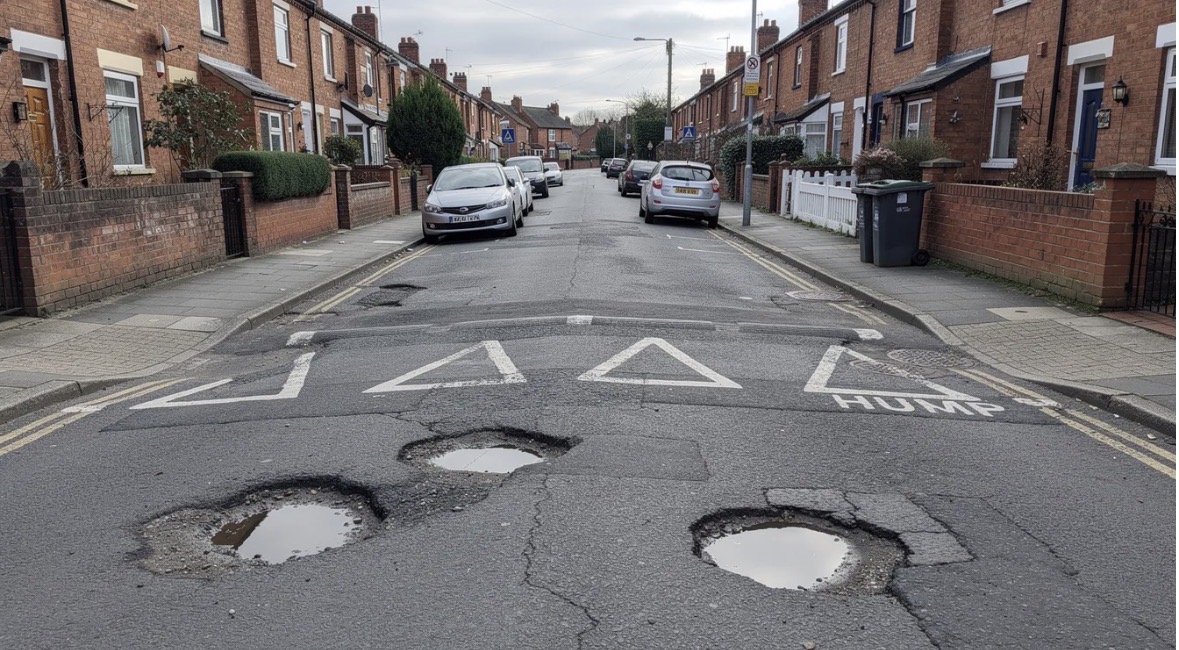

As the UK continues to fine tune its road safety strategy, traffic calming measures have become a vital part of the mix. Whether it’s a 20mph or 30mph limit, built up areas are now being treated to a range of engineered interventions designed to coax drivers into slowing down and prioritise vulnerable road users like cyclists and pedestrians. By 2026, these schemes will be a standard feature on school streets, residential estates, and high streets across the nation.
Common traffic calming measures you’ll find in the UK include speed bumps, speed humps, rumble strips, build outs, chicanes, and speed tables. Theyre often found near schools, on village gateways, and on residential roads where speeding poses the biggest risk to safety. And the evidence suggests they work – studies have consistently shown that speed reduction and fewer serious collisions are the result.
But here’s the uncomfortable truth: some of the UK’s most effective “traffic calming” isn’t even designed that way. Poor road surfaces – potholes, cracked asphalt, crumbling edges, and patchwork utility repairs – are creating the effect unintentionally, as drivers slow down to avoid damaging their vehicles. And this “accidental calming” is achieving similar speed reduction effects without the need for design, consultation, or maintenance budgets.
This article is going to explore the pothole paradox, look at the standard UK traffic calming schemes, and examine what intentional calming measures can learn from the behavioural insights hidden in our decaying roads.
The Pothole Paradox: How Crumbling Roads Are Unintentionally Calming Traffic
Drivers slow down for potholes because it’s instinctive. When you see a deep crater pooling water, a broken edge from a utility reinstatement, or a surface that’s been unevened by freeze-thaw cycles, you ease off the accelerator to protect your tyres, suspension, and alloys. No need to slap up a warning sign.
This behaviour plays out every day across the UK in 2024-2026:
- Rural B-roads where verge overgrowth and water ingress has taken a toll on the road edge
- Urban streets that are scarred by repeated utility patches that fail at the joints
- Estate roads where motorists have to navigate deep craters like an obstacle course
And the evidence backs it up. UK local authorities have seen average speed increases of 2-5 mph after resurfacing deteriorated roads. AA and RAC driver surveys have consistently shown that people report slowing down on hazardous surfaces. The road surface itself has become a de facto traffic calming measure – without a single consultation or budget.
“The worst-kept roads can sometimes be the most effective speed reducers – think of that one.”
But this accidental calming comes with some serious downsides. Unpredictable braking, swerving into cycle lanes or oncoming traffic, higher maintenance costs from damage claims, and elevated safety risks for cyclists and motorcyclists who can’t just “drive round” a hazard. The pothole achieves slower speeds but creates chaos in return.
What Potholes Reveal About Driver Psychology
Why do potholes work when 20mph signs often don’t? It all comes down to how drivers process risk.
Motorists respond much more strongly to immediate, personal costs – damage to their own vehicle – than to abstract risks like speed limit fines or hypothetical crashes. A deep crater pooling water, a sharp-edged failed patch, or a stretch of cracked asphalt triggers instinctive slowing in a way that road markings and polite messages just can’t match.
Consider the contrast:
- Hard deterrents: Deep potholes, harsh rumble strips, sharp speed bumps – these deliver immediate, uncomfortable feedback that gets your attention
- Soft cues: 20mph signs, painted roundels, advisory messages – these require you to think about it and make a conscious decision to comply
The mechanism at work here is “felt feedback”. Drivers adjust their speed when the car shakes, scrapes, or pitches violently. That’s precisely what intentional vertical deflections like speed humps exploit, but in a controlled, predictable way. Research from the Institute for Transport Studies at Leeds confirms that well-spaced vertical measures get 85th percentile speeds down below 30kph (about 18.6mph).
The design lesson is clear: effective traffic calming taps into the same survival instincts that make drivers fear potholes. Abstract appeals to safety just can’t compete with the prospect of a £400 tyre replacement.
From Accidental to Intentional: What Engineered Traffic Calming Is Trying to Do
Planned traffic calming in the UK follows Department for Transport guidance, including Local Transport Note 1/07 and LTN 1/20 for Cycle Infrastructure Design. Local authorities implement these various traffic calming measures in 20mph and 30mph zones to achieve specific objectives.
The goal is to create a controlled, predictable version of what potholes do chaotically: get drivers to slow down at specific points and keep their speed down along the route. But intentional measures also need to balance the needs of all road users – drivers, cyclists, disabled people, buses, HGVs – and support broader objectives like road safety, air quality, and noise reduction.* Stay accessible to wheelchairs, mobility scooters and adapted cycles
- Give equally good treatment to all different neighbourhoods
The trade-off is pretty obvious. Intentional traffic calming requires up-front investment, some community consultation, and some ongoing maintenance. On the other hand, just letting potholes appear “for free” leads to all sorts of hidden costs – like damage claims and injury liability, and the risk of injury to vulnerable users. One way of doing things is thought-out and deliberate; the other is just letting things fall apart.
Core Traffic Calming Measures Used in the UK
The UK has been employing three main categories of traffic management measures on its streets for some time now:
- Vertical deflection: Speed humps, speed tables, speed cushions, flat top humps – basically anything that uses height to slow you down.
- Horizontal deflection: Chicanes, build outs, road narrowing, priority narrowings – all designed to make you change direction and slow down.
- Surface treatments: Textured surfacing, rumble strips, block paving – these are all about using visual cues to get you to slow down.
Each one is suited to a different context – outside schools, at village gateways, on bus routes, in residential areas. Of course, no matter which one you choose, you have to follow the LTN 1/20 guidance on widths, gradients and comfort for people cycling, or using a tandem or mobility aids.
The following sections go into each type of measure in more detail, including where they’re used and the issues that affect cyclists and disabled users.
Vertical Deflection: Speed Humps, Bumps, Cushions and Tables
Vertical deflections are a pretty effective way of reducing speeds. A study of 35 British traffic calming schemes with humps found that speeds were reduced by an average of 16kph on the 85th percentile – that’s a pretty significant drop.
The key thing to understand is that one size definitely doesn’t fit all:
- Speed bumps: Short, sharp vertical bits that are 25-50mm high and only a metre or so long. They’re often used in car parks where traffic is moving at walking pace, but they can be pretty harsh on a vehicle’s suspension at any speed.
- Speed humps: Smoother, longer profiles (75-100mm high and 3.7-4 metres long) designed for use on public roads. They’re often called “sleeping policemen.” They’re usually used on roads with 20mph or 30mph limits where there’s a known problem with speeding.
- Speed cushions: Narrower humps with gaps that allow cycle wheels and bus axles to pass through – reducing the discomfort for these users.
- Speed tables / flat topped humps: Raised platforms that span the entire width of the carriageway, often at pedestrian crossings or junctions. They can be called raised tables.
UK regulations generally mean that vertical measures are used on lit roads with speed limits of 20mph or 30mph and a history of speed-related problems or collisions. Drivers who are paying attention will spot these features; drivers who are following the rules will get through just fine. It’s only drivers who are exceeding the limits who will experience any real discomfort.
The comparison to potholes is pretty direct – both are using discomfort to force drivers to slow down. But traffic calming features give you a predictable geometry, consistent placement and legally-defined profiles – whereas potholes are just random hazards that catch people out.
Horizontal Deflection: Narrowings, Chicanes and Build-Outs
Horizontal deflection forces drivers to adjust their line and reduce traffic speeds by breaking up long, straight “racing” sections of road. These measures physically narrow the carriageway or create lateral shifts that prevent you from going at a high velocity.
Some common UK applications include:
- Chicanes: Alternating build-outs on one or both sides that force you to weave in and out of them.
- Build-outs: Extensions of the kerb that narrow the traffic lanes in specific places.
- Priority narrowings: Single-lane sections where you have to give way to oncoming traffic.
These sorts of features are often used on residential streets, village entrances on B-roads, and 30mph approaches to town centres. Research has shown that chicanes, in particular, can lead to a 29% reduction in accidents after accounting for general trends and changes in traffic flow.
Designers have to bear in mind that cyclists and larger vehicles need to have minimum widths from LTN 1/20 – approximately 3.25m to 3.9m – to allow safe overtaking and side-by-side running. Poorly designed narrowings that pinch riders into conflict with cars make things worse than speeding ever did.
These features are physically obvious and signposted, so they reduce sudden braking and encourage steady, anticipatory driving.
Benefits and risks:
- Speeds are lower, noise from acceleration is reduced
- Drivers get visual cues that something’s changed
- There can be driver frustration if poorly designed
- Inadequate widths can lead to drivers taking risks with overtaking
Surface Treatments, Rumble Strips and Optical Narrowing
Surface treatments are all about using psychology to get drivers to slow down. They signal to drivers that they’re entering a slower-speed or higher-risk area without physically obstructing the road.
Key approaches include:
- Rumble strips: Raised bars or grooves that make a noise and vibrate as a warning. UK guidance advises avoiding them near housing due to noise concerns, but they’re used on rural route approaches.
- Block paving: Textured surfaces at pedestrian crossings, junctions, or village centres that signal a change in environment.
- Coloured surfacing: Anti-skid treatments at crossings, high-friction surfaces on bends.
- Optical narrowing : Taking the centre lines out on quiet streets, and using edge markings and hatching to make the running lane look narrower
The psychological impact of this is very similar to what happens when drivers have to navigate a patchwork of pothole repairs. Both send a clear signal that this isn’t a fast road – but which one is designed to be safe and accessible for everyone?
Appropriate uses:
- Rumble strips: only use these at rural gateways and approaches to traffic lights, and only for part of the approach zone
- Block paving: this is great for town centres, parking bays and areas where pedestrians have priority
- Optical narrowing: try this on residential roads and streets with parked cars that leave the actual width of the road a bit tricky to tell
Traffic Calming vs Potholes: Safety, Comfort and Liability in the End
Both engineered calming measures and un-managed potholes can knock speeds down – but only one of those approaches is designed to be survivable, predictable and include everyone.
Key contrasts:
The data on potholes shows that they make for a whole lot more near-misses and actual crashes for motorcyclists and cyclists. Drivers weaving to avoid potholes end up doing all sorts of unpredictable things that put other road users in harm’s way. On the other hand, properly thought-through calming schemes reduce the chances of severe impact crashes by slowly bringing speeds right down in a controlled way.
Local authorities are swamped with claims every year from people who’ve damaged their cars on potholes. The free speed reduction that comes from potholes eventually ends up costing a lot more than investing in traffic calming schemes that are actually planned.
Data and Case Studies: What the Numbers Actually Show
Loads of UK and European studies have shown that properly designed calming really does work:
- Vertical deflections : they can knock speeds down by as much as 10-16 kph
- Comprehensive schemes : can cut collisions by as much as 40%
- Whole area 20mph zones : if you do these in conjunction with some proper physical measures, drivers actually stick to it
The resurfacing effect:
Asset management data shows that the pothole paradox is real. Roads that are resurfaced to get rid of potholes often end up with drivers driving faster on the shiny new surface. And that’s exactly what we need to counteract with some intentional calming.
Case examples:
- Borehamwood, Shenley Road : 18,000 vehicles a day down a road that was narrowed from 18m to 7m effective width using planting and build outs. Result? Loads of pedestrian safety gains
- Bristol chicanes : a study found that these reduced accidents by 29%
- Sowerby Bridge gateway : used rumble strips and build outs to manage 1600 vehicles per hour at peak time, with great results
But all too often, badly deteriorated roads will slow traffic down alright – but at the cost of making drivers do all sorts of unpredictable things and upping the risk for vulnerable users.
Design Lessons: What Intentional Calming Can Learn from Potholes
The pothole paradox gives us some really useful lessons for better traffic calming design:
- Visible consequences work: Drivers respond to tangible threats, so we need to combine visible cues with some real feedback to make it work
- Tune in the discomfiture: make vertical measures uncomfortable enough at high speeds to get drivers to slow down, but not so much that it punishes drivers who are already going the right speed
- Context-sensitive resilience: in areas where maintenance budgets are tight and the surface is going to rapidly deteriorate, go for calming designs that stay safe as the surface gets worse – e.g. use forgiving ramps instead of harsh edges that get in a bad state when they crack
- Conspicuity is key: features need to be visible at night and in the rain so drivers aren’t caught out. Puddle-filled potholes can lead to panic braking, but visible, well-marked humps encourage smooth deceleration
- Self enforcing design: the best measures don’t rely on signs alone. They tap into drivers’ instincts and make compliance the natural thing to do
Maintenance, Materials and the Role of Reliable Asphalt Suppliers
Long-term calming effectiveness is all about the quality of the surfacing. If you use materials that are not up to scratch around humps, tables and narrowings, they quickly start to break down and ruckle – and that turns perfectly good calming measures into de facto potholes.
Working with a reliable asphalt supplier who provides the right mix for high-stress locations is essential:
- Approaches to humps where braking concentrates the wear
- Bus routes where heavy axle loads stress the surface
- Gateway zones where deceleration creates specific loading patterns
Procurement and specification principles:
- Get the right binder course for braking and acceleration zones
- Proper compaction and jointing around vertical features
- Drainage that works to prevent water getting in and causing freeze-thaw damage
- Coordinate with planned resurfacing to make sure calming and maintenance are happening in sync
The data consistently shows that cheap initial surfacing plus a lot of patching is a false economy. You’re better off spending a bit more upfront on good quality asphalt and planned maintenance – as Devon County Council and other authorities have found out.The pothole paradox holds a bit of an uncomfortable truth about how drivers really react to risk. Those pesky potholes , they’re actually slowing traffic down for the wrong reasons – fear of having to shell out cash for repairs on their own car rather than some genuine concern for the safety of others. Clever UK traffic engineers have found a way to tap into the same instinct safely and fairly.
Key takeaways:
- Prioritise good looking and well-designed vertical and horizontal measures instead of just letting things run down
- Use behavioural insights to get results: drivers really do respond better to a nice big sign saying “Hey, slow down” than some vague message about road safety
- Put money into good quality materials and use a reliable asphalt supplier to make sure you don’t have to come back and fix things all the time
- Be upfront with local community about what they’re getting – are it’s gonna be quiet and boring, or nice and easy to get in and out of but a bit noisy – let them have a say
The idea here is to stop relying on dodgy maintenance as a way to keep traffic under control & instead build and maintain streets where everyone feels happy to drive at a sensible speed – without all the bumps and potholes